Welcome to the Freemium Future
This essay is part of Thinking in Public, a series exploring the uncertain, exponential moment we’re living through. Each piece looks through a systems lens at how AI, politics, and capitalism are reshaping one another — and, ultimately, society itself. Writing these essays is my way of making sense of what’s happening — to process out loud, to self-soothe, and to share in case it helps others do the same. Read the series preface here.
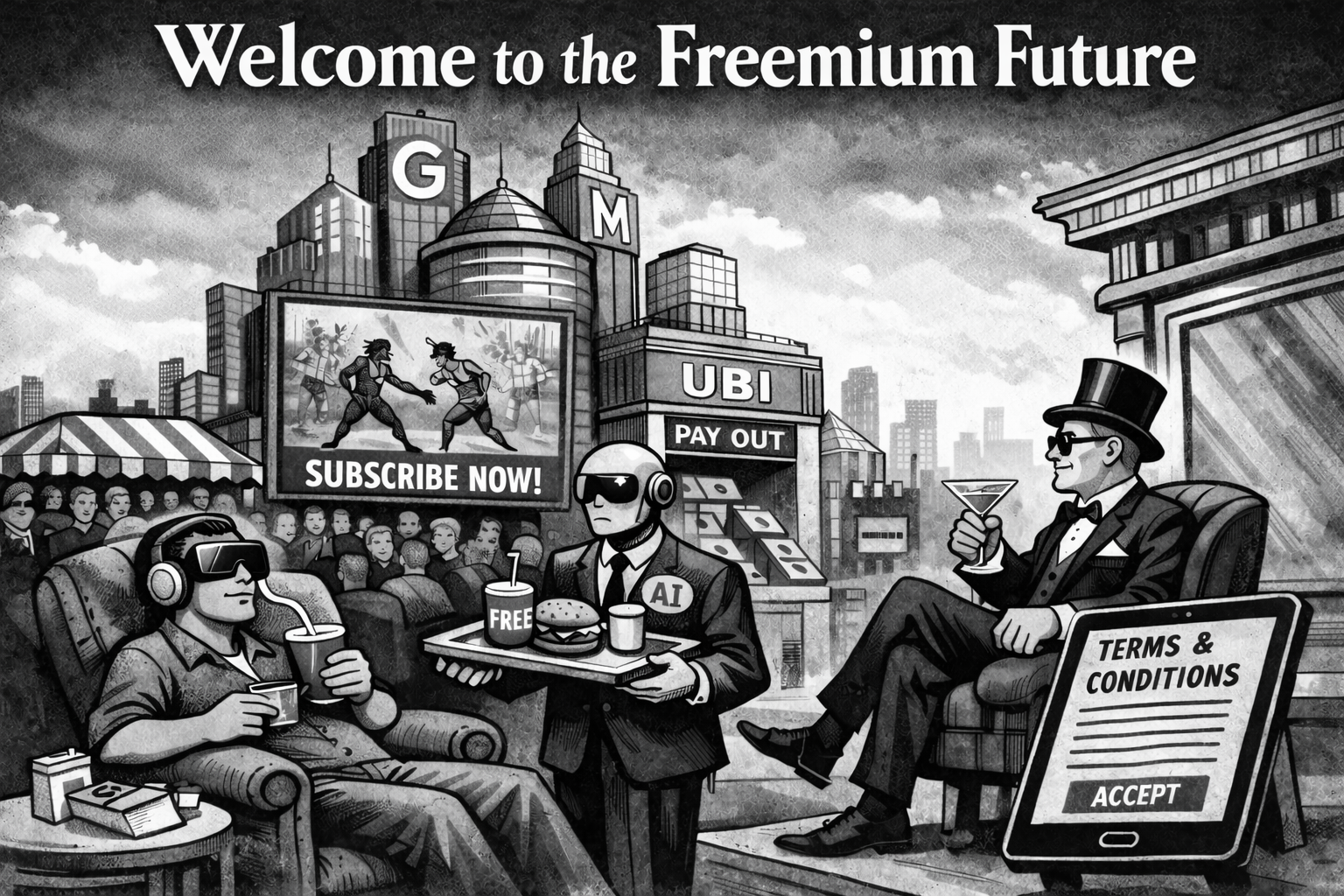
AI is breaking the economics we built the world on.
Much of the fear around AI is focused on intelligence — what happens when machines outthink us, outgrow us, or slip beyond our control. Think Skynet, Ex Machina, The Matrix.
But before any of that comes to pass, AI is already doing something far more immediate and disruptive: it’s breaking the basic mechanics of modern economics.
As AI and robotics quietly consume job after job — while simultaneously driving the marginal cost of production toward zero — economics as we know it will no longer function. The model that emerges may not look like cinematic dystopia, but something far more familiar (and far more efficient): a global, corporate-run freemium economy.
In many ways, we’re already living inside it. Much of the digital world we depend on — search, email, maps, media, knowledge — is free at the point of use, subsidized by data, attention, and advertising. What’s new is that AI and robotics threaten to extend this logic beyond software and into the physical world.
And that’s where things get interesting.
The Economics of Abundance (or the Death of Demand)
There’s one little hitch in the AI-fueled vision of infinite abundance: consumers need money.
When machines run the factories, design the products, drive the trucks, and write the code, the connection between labor and income breaks. Wages stagnate. Jobs disappear. The middle class — the golden goose of capitalism — starts to erode.
At the same time, supply doesn’t slow down. It accelerates. This creates a paradox at the heart of AI capitalism:
You can’t sell infinite goods to people with zero income.
Even the most automated, data-driven empire still needs someone on the other end of the transaction. Someone to click Buy Now. Someone to subscribe. Someone to consume.
Historically, this is where politics steps in — redistribution, welfare, safety nets, UBI. But as I explored in The Last Social Contract, politics is increasingly slow, polarized, and structurally incapable of responding at the speed these systems now move.
Which leaves a vacuum. And nature — economic or otherwise — abhors a vacuum.
Why Freemium Solves Capitalism’s Demand Problem
Here’s the non-obvious part: the freemium model isn’t just convenient — it’s stabilizing.
From a corporate perspective, freemium solves several existential problems at once:
It restores demand without restoring wages
It keeps consumption alive even as employment collapses
It maintains corporate growth narratives when income growth stalls
And critically, it reduces the risk of social unrest
Offer everyone enough to survive — food, shelter, healthcare, entertainment — but not quite enough to thrive. Keep basic needs met, engagement high, and aspiration just out of reach. Revolution becomes unnecessary.
Universal Basic Income? Maybe.
Corporate Basic Living Package™? Far more likely.
After all, why wait on paralyzed governments when platforms already know what everyone eats, watches, buys, and believes? This isn’t generosity. It’s demand engineering.
The Gentle Coup of the Corporatocracy
Nation-states were a remarkable experiment. But they weren’t built for the exponential curve.
Corporations already move faster than governments, legislate via terms of service, and mint their own currencies (points, credits, tokens, crypto). They manage global logistics, cloud infrastructure, and big data.
As wealth and control of production consolidate into a handful of megacorporations and tech dynasties, the next step isn’t rebellion — it’s substitution. Corporations don’t overthrow states; they route around them.
Freemium provision of basic needs becomes not just an economic model, but a political stabilizer. When people are fed, housed, entertained, and monitored, the system holds — even if no one voted for it.
The Technocrat Temptation
And here’s the weird part: I’m not sure this future is entirely cynical.
After all, we all see how broken modern politics has become, especially in the U.S. Institutions designed for a pre-internet era are struggling to govern a hyperconnected, algorithmically filtered, perpetually outraged society. Two-party deadlock, campaign-finance distortion, gerrymandering, polarized media ecosystems, and the collapse of shared truth have warped democracy into something barely recognizable.
Against that backdrop, it’s not hard to understand why some technologists believe they could do better. I go back and forth on whether the billionaire class is simply playing a zero-sum power game — or whether some genuinely believe they can build a better world by routing around the broken, messy realities of politics.
Abundance for All (Terms and Conditions Apply)
If you squint, there’s real optimism here.
Automation really could end scarcity. AI really could liberate humanity from meaningless labor. We might genuinely enter an age of post-work prosperity.
And in many ways, we already have. Between Google, Gmail, Wikipedia, YouTube, and the rest, most of us carry more knowledge in our pockets than the President did a few decades ago. Whatever else you say about capitalism, it has dramatically raised the baseline of material and informational abundance.
The only catch is who owns the robots.
If history is any guide, it won’t be “us.” It’ll be the companies that built them — and the investors who backed those companies. Which means our abundant, automated future will likely arrive as a subscription service.
The good news: everyone gets access. The bad news: the cancel button won’t work.
Final Thoughts
So yes — maybe AI will take our jobs, our political leverage, and eventually much of what we think of as democratic governance. Maybe the corporate class will consolidate into a handful of entities that manage the planet through data centers, energy grids, and behavioral feedback loops.
But look on the bright side.
Your freemium plan will include food, healthcare, entertainment, and cloud storage. And you’ll never go hungry (unless your account is suspended…).
Welcome to the Freemium Future.
